
Arrest Records in Lorain County
An arrest record is a snapshot of a booking. It shows who was taken into custody, when, and on what charges at the moment of intake. In Lorain County, the Sheriff's Office runs the county jail and books people brought in by deputies and by city police agencies. Lorain Police, Elyria Police, and the Adult Probation Department all show up as booking origins in the jail data. So an arrest record can begin with a city officer, but the booking itself runs through the sheriff.
That makes the sheriff the main source for current arrest and booking data. The record at this stage is not a finding of guilt. It logs an accusation and a custody event. The deeper file, the one with pleas, motions, and a final outcome, lives with the court. For full case history, see the Lorain County court records page. Arrest data answers a narrower question: who is in jail right now, and why were they booked? These are sometimes called criminal records in casual use, but a booking entry and a court case are not the same thing.
How to Search Lorain County Arrest Records
The fastest route to recent arrests is the Sheriff's Inmate Inquiry. It is a free public tool built on a Tyler Public Safety platform. You can search by name, by booking number, or by subject number, and filter by booking date or current custody status. A match opens an inmate profile with booking history, bond, charges, and court dates. The steps below walk through a basic name lookup.
- Open the Sheriff's Inmate Inquiry portal from the official sheriff site.
- Type a full or partial name, or enter a booking number if you have one.
- Set the booking date range or the In Custody filter to narrow recent arrests.
- Open a result to read the booking record, charges, and any scheduled court dates.
- Call the Records Division to confirm details or to ask for an official report.
The jail roster shows people in or recently moving through custody. It is the closest thing to a public arrest blotter for the county. For someone who has already left the jail, use the released inmates page. To check the full roster and profile fields, the inmate records page goes deeper. Lorain County does not publish a separate statewide-style arrest log beyond this booking system.
Arrest Record vs Criminal Court Record
People treat these as one thing. They are not. An arrest record is created at booking by the sheriff or a police agency. A criminal court record begins later, when a prosecutor files charges and a case opens with the clerk. One is a custody log. The other is a case file that grows over months. The table below lays out the split.
| Arrest Record | Criminal Court Record | |
|---|---|---|
| Source | Sheriff or city police | Clerk of Courts |
| Created When | At booking | When charges are filed |
| Contents | Booking data, intake charges, bond, mugshot | Indictment, pleas, motions, disposition, sentence |
| Where to Look | Sheriff Inmate Inquiry | Clerk eServices docket portal |
A felony case moves to the Court of Common Pleas. Misdemeanor and traffic matters stay in a municipal court. The court file is where you find the result, not the jail roster. For that full history, the court records page covers the docket search step by step.
Charges vs Convictions in Lorain County
This is the single most misread part of any arrest record. Being charged is not the same as being convicted. A charge is what the state claims at the start. A conviction is the result, reached only after a plea or a trial. An arrest record can list serious charges that the court later drops, reduces, or rejects. Read the charge field as an accusation, never as a verdict.
| Charge | Conviction | |
|---|---|---|
| Stage | Accusation at or after arrest | Verdict or guilty plea |
| Burden of Proof | Probable cause | Beyond a reasonable doubt |
| Recorded By | Sheriff or police | The court |
| Public Record | Yes, usually | Yes, unless sealed |
The disposition field tells the real story. Watch for terms like dismissed, not guilty, no bill, or judgment. In the jail data, even a disposition note such as Bond Posted or Personal just marks the custody status, not the final case outcome. DUI and OVI arrests often start here but resolve in a municipal court. Those traffic-linked cases are covered on the traffic court records page.
Sealed vs Expunged Records
Ohio lets eligible people clear certain records from public view. There are two tools, and they are not equal. Sealing hides a record from the public while keeping limited government access. Expungement goes further and destroys or deletes the record, so it is treated as if it never existed. Both need a court order. The table sorts out the difference.
| Sealed | Expunged | |
|---|---|---|
| Visibility | Hidden from public view | Destroyed or deleted |
| Law Enforcement | Limited access kept | Very limited, near none |
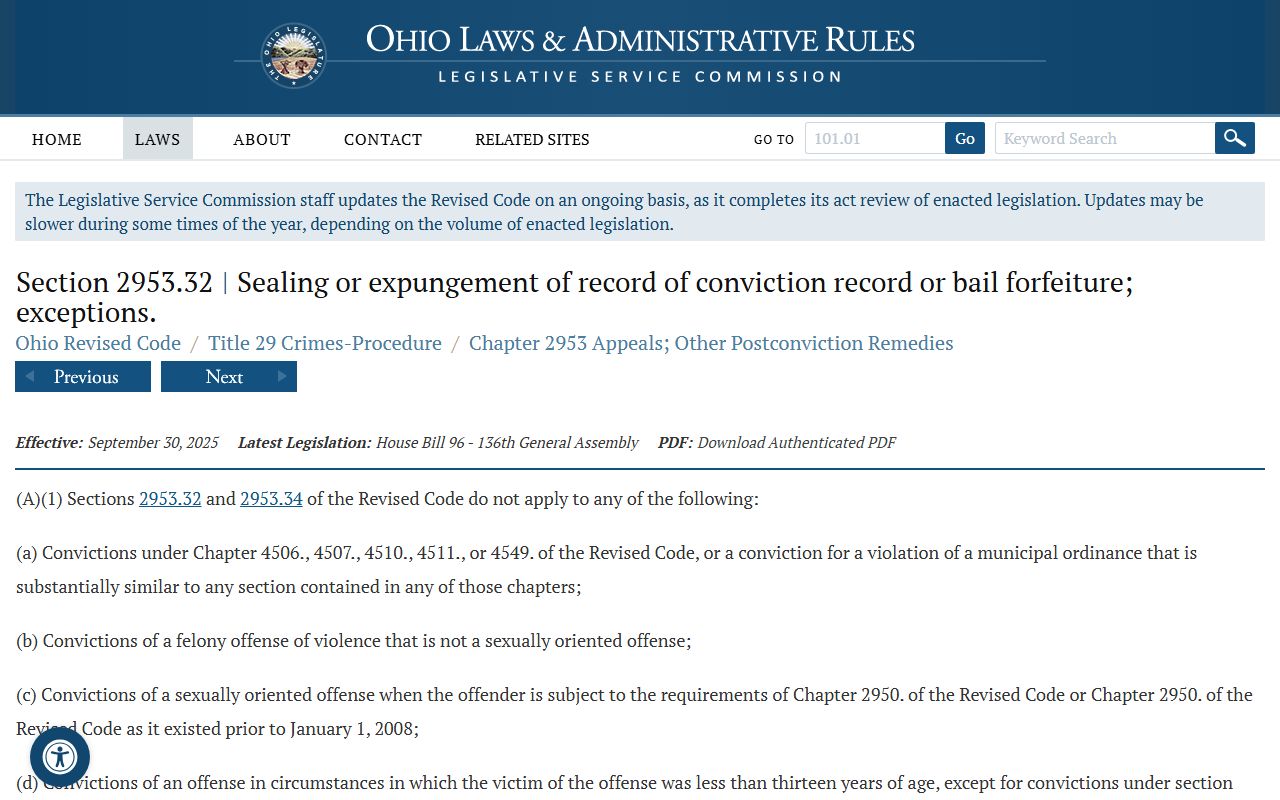
| Governing Statute | ORC 2953.32 / 2953.52 | ORC 2953.32 |
| Eligibility | Convictions, dismissals, no bill | Stricter, fewer offenses qualify |
For a conviction or a bond forfeiture, Ohio Revised Code § 2953.32 sets the rules. The official statute page is shown below.
When charges end without a conviction, a different statute applies. A dismissed, not guilty, or no-bill case runs through Ohio Revised Code § 2953.52, the text of which appears here.
You file the motion in the court that handled the case. The Lorain County Common Pleas fee schedule lists a $50 filing fee for a sealing or expungement application, and Avon Lake Municipal Court lists the same $50 fee. The court weighs eligibility, waiting periods, excluded offenses, and whether fines and costs are paid before it grants relief. Some offenses can never be sealed under ORC 2953.36. A sealed record does not vanish from every government view; police, licensing, and sentencing uses may keep limited access under statute.
Mugshots and Booking Photos
Booking photos are part of the jail record. The Sheriff's Inmate Inquiry profile can show one or more booking photos, each with a timestamp tied to a booking event. These appear in the public profile alongside the demographic and booking details. So a mugshot is usually visible while a person is in or recently through custody.
Use them with care. A booking photo marks an arrest, not guilt. It can stay tied to a record even after a case is dropped, which is part of why sealing exists. The public profile does not show confidential flags such as medical or watch status, so do not read anything beyond what the page actually lists.
Statewide and Federal Criminal Records
A local jail roster shows county bookings, not a full criminal history. For a statewide record, Ohio runs criminal history checks through the Bureau of Criminal Investigation under the Attorney General. That process uses fingerprints and is the standard route for an official Ohio record. County arrest data and a statewide history are separate things, and the jail roster will not stand in for a formal background check.
Some charges are not state matters at all. Federal crimes are prosecuted by the U.S. Attorney's Office for the Northern District of Ohio, which covers Lorain County. Their office page is shown below, and federal cases are handled in federal court, not the county system.
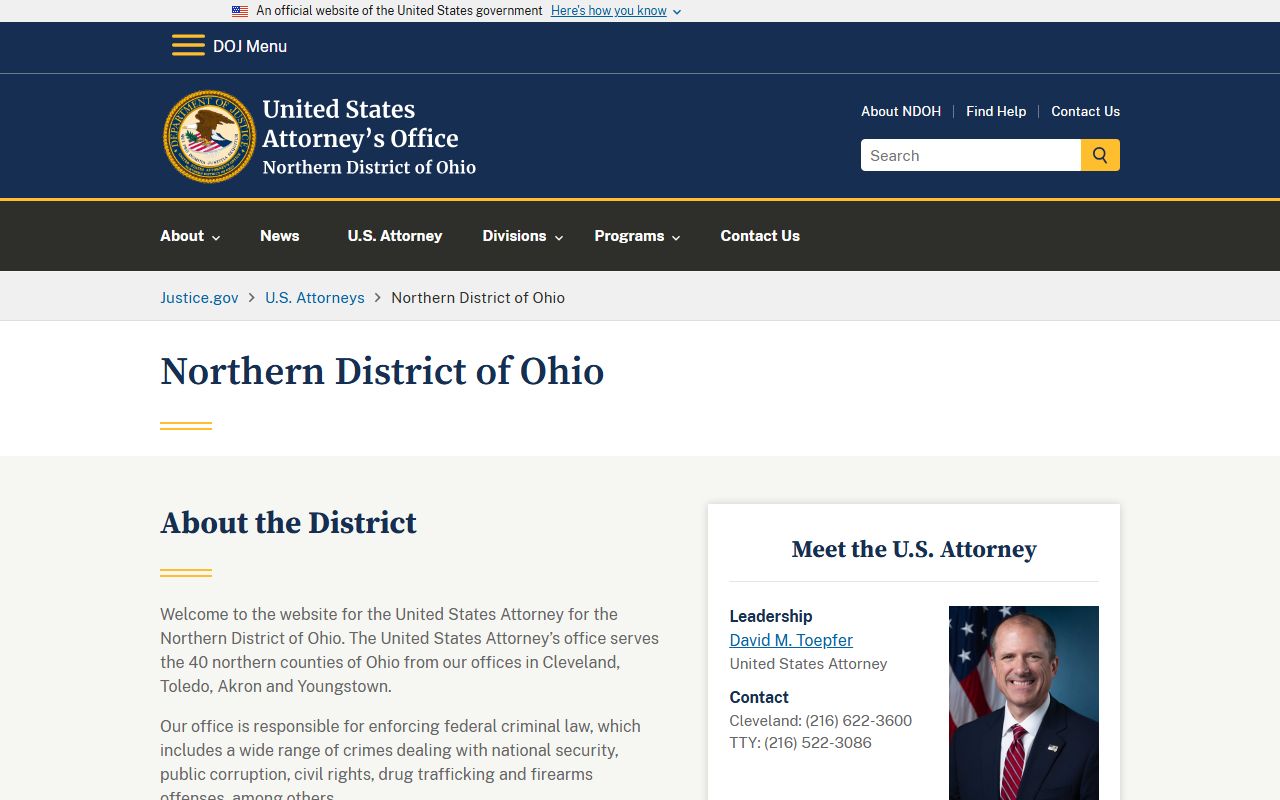
So a complete picture can pull from three levels: county booking data, the Ohio BCI history, and federal court records. The Prosecutor handles the state's felony cases at the county level, which leads into who runs that office.
The Lorain County Prosecutor
Ohio calls the office the Prosecuting Attorney, not a District Attorney. The Lorain County Prosecutor is Anthony Cillo, often listed as Tony Cillo. The office represents the State of Ohio in felony criminal matters, advises county government, and takes part in some civil and child-support proceedings. After an arrest, it is the Prosecutor who decides what charges to file, which is the step that can turn a booking into a court case.
The county directory lists the Prosecutor's contact details, shown here.
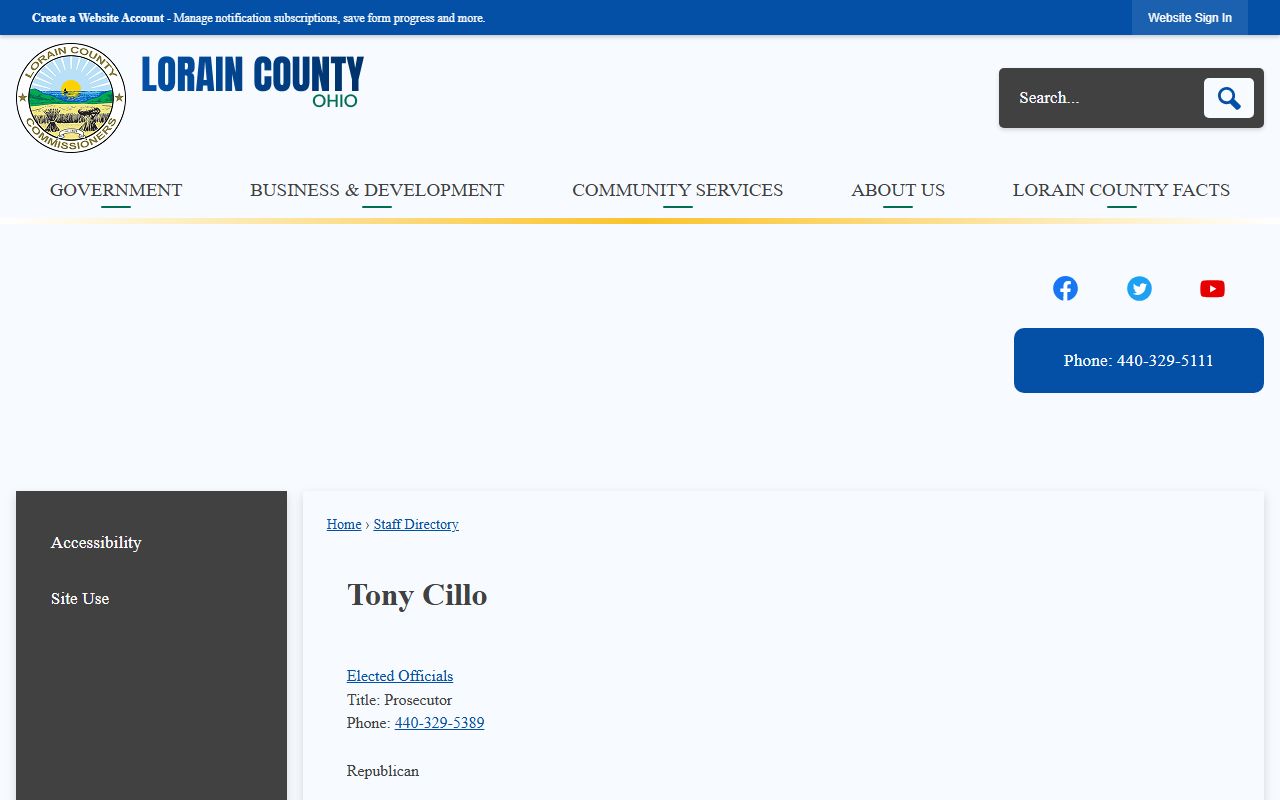
You can reach the Prosecutor through the county directory page. The office sits at 225 Court Street in Elyria. For appointed defense, a person should ask the court handling the case about a financial disclosure form for court-appointed counsel.
Background Check Considerations
An arrest record lookup and a formal background check are not the same. A casual roster search shows a booking. A background check used for hiring, housing, or credit is governed by the Fair Credit Reporting Act and must run through a regulated consumer reporting agency. Free county data is fine for personal use, but it cannot be used to make those regulated decisions.
Important: This site is a private resource and is not an FCRA-regulated consumer reporting agency. Do not use it for employment, tenant, credit, or insurance screening.
Restricted Criminal Records in Lorain County
Not every arrest leaves a public trail. Ohio law walls off several record types. Juvenile arrests fall under juvenile law, which restricts public access. Sealed and expunged cases drop from public view once a court grants the order. Adoption files are confidential. Mental-health details, victim safety information protected by Marsy's Law, and personal identifiers like Social Security numbers are redacted or withheld.
Active investigations can also stay closed. Law-enforcement investigatory work product is exempt from disclosure in some cases under the Public Records Act. So a recent arrest may show in the jail roster while the deeper investigative file stays private. For active matters and capias entries, see the Lorain County warrant records page.